







Search Results for: hearing-impaired employment
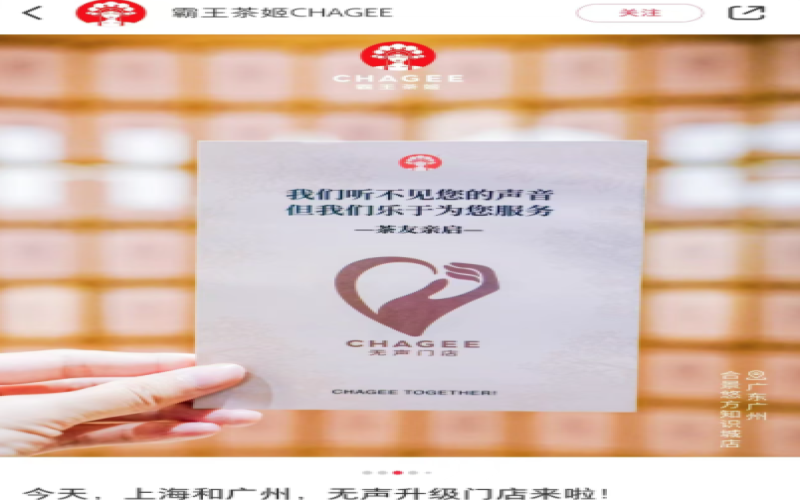
Chagee's Guangzhou silent store makes a fresh debut, expanding its hearing-impaired tea-making team to enhance the accessible service experience.
In the hustle and bustle of the city, a cup of tea can also convey silent warmth. Chagee recently announced a comprehensive upgrade of its "Silent Store" program, with its first Guangdong location opening at Guangzhou's Kwun Tong Plaza. This store, where hearing-impaired individuals serve as tea makers, not only provides equal employment opportunities for special groups but also creates an inclusive and friendly tea-drinking space through upgraded accessibility facilities, sign language communication guides, and other details. This article will walk you through the unique features of this store and review the pioneering explorations of brands like Starbucks in the silent store sector, examining how a cup of tea can connect understanding and respect among different groups. [more…]

Visiting Manner's Most Tranquil Store: The Warm Practice of Silent Baristas and Disability Employment
In the coffee consumption experience, interaction with baristas is often a bonus. But when you encounter a hearing-impaired barista, communication shifts from speech to pen and paper. Recently, a customer at a Manner store noticed a sign on the counter reading "I am a silent barista," leading to a quiet yet warm consumption experience. Some were moved by the focus and effort of silent baristas, while others pointed out the practical efficiency challenges in collaboration from an employee's perspective. In recent years, with policy encouragement and corporate participation, silent cafes have emerged in multiple cities, providing not only jobs but also livelihood skills. Front Street Coffee has observed that to bridge the communication gap, some stores are trying solutions such as sign language menus and voice-to-text devices. This article will present multiple perspectives from consumers, employees, and brands to explore the real situation and future possibilities of silent baristas in chain stores. [more…]

A coffee shop staffed by the hearing-impaired posted a plea for help during the pandemic. After reopening, with zero foot traffic, how did they save themselves through original drip coffee bags?
A silent coffee shop in Shanghai, staffed mainly by hearing-impaired baristas, published an article titled "Please rest assured, we are still alive. But..." on June 14, quickly gaining over 80,000 views. Under the impact of the pandemic, dine-in service was suspended, delivery communication was hindered, and masks obscured lip-reading, plunging the shop into a situation of zero revenue and zero foot traffic. The baristas hand-drew 12 touching moments from those months into illustrations and launched an original themed drip-bag coffee set as a self-rescue effort. The article reviewed the real difficulties this special coffee shop faced, its self-rescue methods, and business adjustment ideas that coffee shops could draw on during the pandemic, including joining delivery platforms, ensuring product quality, designing offline discounts to bring customers back, and developing peripheral products such as drip bags and coffee beans to meet consumers' shifting demand from "going to the shop" to "having it at home." [more…]

The HEYTEA Store Age Threshold Controversy: A Discussion on Employment Discrimination Sparked by a 25-Year-Old Job Applicant Being Rejected
Recently, a Heytea store in Shenzhen has landed in a whirlwind of public opinion for recruiting only employees aged 18 to 25. After a job seeker over 25 was rejected, it sparked heated discussion among netizens. Some criticized it as blatant age discrimination, while others believed that because work at milk tea shops is intense, companies have the right to choose freely. Behind the incident, it reflects the widespread preference for the "youth dividend" in the current job market, as well as the difficulties faced by middle-aged job seekers. Legal professionals pointed out that such a practice is suspected of violating the Labor Law and the Employment Promotion Law, and the Shenzhen Federation of Trade Unions also spoke out in criticism. Heytea responded that it was a communication deviation at a single store. Who is right and who is wrong in this controversy? Will young people over 25 still continue to drink Heytea? [more…]
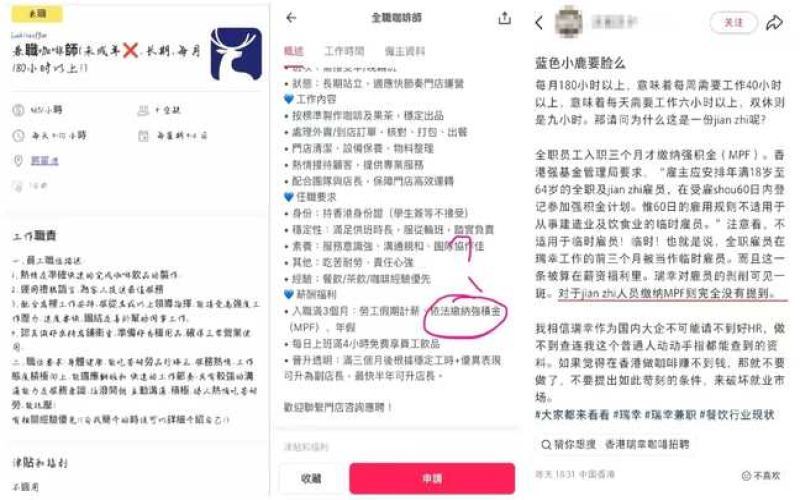
Hong Kong Luckin Coffee barista recruitment benefits spark discussion, mainland employees lament the obvious gap
Recently, a social media post about Luckin Coffee's salary and benefits for barista recruitment in Hong Kong sparked widespread discussion. The post noted that full-time baristas at Luckin in Hong Kong are entitled to paid statutory holidays, MPF, and annual leave after three months of employment, while the recruitment information for part-time positions did not explicitly mention MPF contributions. This detail quickly ignited enthusiastic discussion among Luckin workers in mainland China, with many expressing mixed feelings after comparing the treatment in the two places. However, clarification from Hong Kong netizens offered another layer of interpretation—the MPF is fundamentally an employer's statutory responsibility, not an extra benefit. This cross-border discussion reflects differences in awareness of labor rights. Front Street Coffee continues to follow developments in the coffee industry and brings you in-depth analysis. [more…]

Shuyi Shao Xian Cao Store Fined for Illegally Employing a 13-Year-Old Worker, 10,000 Yuan Penalty Draws Attention
The milk tea industry has recently exposed yet another labor abuse scandal. A Shuyi Tealicious store in Changsha was fined 10,000 yuan by the local Human Resources and Social Security Bureau for hiring a child worker who was only 13 years old. The incident came to light after a citizen report, and an investigation found that the child had worked at the store for several months before being fired, which then led to a dispute. The store owner involved argued that the child claimed to be over 15 years old and that they only agreed to hire the child because they were short-staffed. This case not only highlights loopholes in employment management at some food and beverage outlets, but also sparked public discussion about the protection of minors and the enforcement of labor laws. [more…]

Luckin Coffee's hiring policy sparks heated debate: the costs and prejudice behind rejecting job applicants with Shanghai residency
Recently, Luckin Coffee has sparked widespread controversy due to a shortage of staff in its stores caused by reforms to its employment system, while simultaneously rejecting local job applicants in Shanghai during recruitment. A Shanghai netizen applied for a part-time barista position but was directly turned down because their ID number began with '310', with the reason given being 'currently Luckin in Shanghai does not accept locals'. This incident reflects companies' stereotypes about local job seekers—such as being 'unable to endure hardship' and 'demanding social insurance'—and also touches on practical considerations like high social insurance contribution bases and labor cost control. Against the backdrop of a simultaneous labor shortage and employment difficulties, is Luckin's recruitment strategy reasonable? And how should the rights and interests of local job seekers be safeguarded? This article will delve into the multiple factors behind this phenomenon. [more…]

Former Employee at a HEYTEA Franchise Exposes Unpaid Overtime: Excess Hours Worked Without Overtime Pay, Instead Fined — Brand's Employment Standards Draw Attention
Recently, a former employee of a HEYTEA franchise store publicly shared on social media their experience of unfair employment treatment, quickly sparking heated discussion among netizens. The employee posted clock-in records and chat screenshots, pointing out that they had worked overtime for a long time without ever receiving overtime pay, but were instead deducted 700 yuan for being late, and the promised base salary did not match reality. More notably, the franchise store's autonomy in salary management made it difficult to protect employee rights, bringing the disparity in treatment between directly operated stores and franchise stores to the surface. This article summarizes the course of events and various viewpoints for reference by coffee industry practitioners. [more…]

On his first day on the job, a Mixue Bingcheng employee unexpectedly died suddenly, sparking heated debate over how legal liability should be determined.
Recently, Mixue Bingcheng made trending news due to an employee's sudden death. According to media reports, a female employee in Jingdezhen, Jiangxi, suddenly collapsed after working only three hours on her first day on the job and tragically passed away despite rescue efforts. Mixue Bingcheng responded that they are negotiating with the family, and the incident is still under investigation. This tragedy is not only lamentable but has also sparked widespread discussion on legal issues such as employer liability, work-related injury determination, and social insurance contributions. At the same time, Mixue Bingcheng's previous fine for employing child labor has been brought up again. The health and rights protection of workers has once again become a focal point. [more…]

Cotti Coffee Job Applicant Asked to Buy Their Own Uniform Sparks Controversy: Is It Legal to Pay for Your Own Work Uniform?
Recently, a job seeker on a recruitment platform questioned a Cotti Coffee store manager about the requirement to buy their own work uniform, only to be hit back with "Has your family fallen on hard times?" — sparking widespread discussion online. Cotti's customer service responded that its operating stores are all partner stores, and uniform requirements are decided by the store manager. So, is it legal for employees to pay out of pocket for work uniforms? Article 9 of the Labor Contract Law has clear provisions on this, but the specifics depend on the situation. This article sorts through the course of events, the legal boundaries, and netizens' views, and includes Front Street Coffee's professional communication channels. [more…]

Luckin franchise store pays only 4 yuan for 4 days of trial work, Front Street Coffee focuses on labor rights dispute
Recently, a newly resigned worker posted on social media accusing a Luckin Coffee franchise store in Shandong of unreasonable employment practices, claiming that after four days of training they received only 4 yuan in wages. The incident quickly sparked heated discussion among netizens, with many suggesting seeking help through police report or labor arbitration. Subsequently, the store manager recalculated the pay at 10 yuan per hour for 25 work hours. Other netizens also reported similar experiences at the same store. Front Street Coffee is paying attention to this matter and calls on the brand to intervene to protect workers' lawful rights and interests, while also reminding coffee enthusiasts to be aware of how employment misconduct at franchise stores can negatively impact the brand's image. [more…]
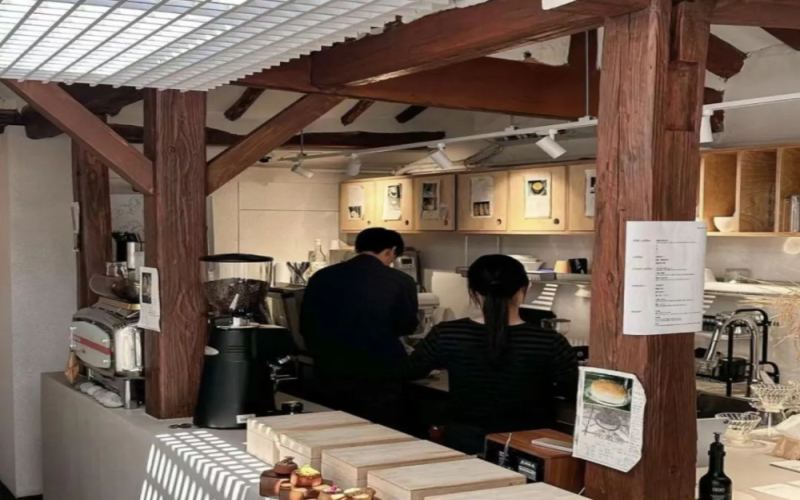
Is the barista profession really in trouble? A multidimensional analysis of the current employment situation and future development paths
As coffee culture becomes increasingly popular in China, the profession of barista has attracted the attention of more and more young people, but at the same time, doubts about its job prospects have never ceased. Some people ask on social platforms: Have baristas already lost their market? Beginners repeatedly hit walls when job hunting, and resumes submitted on recruitment platforms often get no response. Unless one holds an SCA certificate, has years of experience, or has outstanding appearance, it is very difficult to get an interview opportunity. However, there are also views that independent coffee shops prefer to hire offline, and practical ability is far more important than certificates and resumes. Are baristas just a youthful job, or is it a profession with diverse development paths? This article will focus on these discussions, sorting out the current situation of the barista job market, the competitive pressure they face, and future出路, to help coffee lovers understand the possibilities of this profession more comprehensively. [more…]

Master's graduate joining Luckin Coffee sparks debate: the new employment trend behind highly educated talent flowing to coffee counters
Recently, the news of a fresh master's graduate choosing to join Luckin as a part-time barista has sparked widespread discussion online. Supporters believe that no occupation is superior or inferior, and that young people should try more things; opponents feel that this is a waste of a diploma. In fact, as the number of graduate students in universities surpasses that of undergraduates, under the dual pressure of degree devaluation and economic downturn, more and more highly educated young people are turning their attention to light physical service industries such as coffee and tea drinks. They either want to escape the high-pressure, hyper-competitive office environment, or use it as a transitional job. However, is the real experience behind the bar counter of chain brands as relaxed and comfortable as imagined? This article deeply explores the multiple motivations and real dilemmas behind this phenomenon. [more…]

Café Owners Take Outside Jobs to Subsidize Their Shops: Why Independent Coffee Operators Choose Part-Time Work to Survive
How tough is the coffee business this year? Many independent café owners have found that store revenue alone is no longer enough to support themselves, let alone get rich from coffee. To keep the small shops they poured their hearts into, some have pivoted to food service, some have thrown themselves into social media marketing, some have launched membership top-up schemes to lock in regulars, and some owners have simply chosen to take outside jobs, using their wages to subsidize the café's daily expenses. How do these "re-employed baristas" juggle their main business and side gigs? And are employers willing to hire someone who is themselves a fellow café owner? This article takes you inside the real circumstances of these coffee operators who persist out of love. [more…]

Climate change hits Costa Rica's coffee industry: drought causes production decline, export and employment face chain pressure
Costa Rica has long ranked among the world's leading coffee producers and exporters, thanks to its volcanic soil, mild climate, and abundant rainfall. In recent years, however, persistent high temperatures and drought have been eroding its growing environment. In the Desamparados canton, a key production area in the Central Valley, some estates have seen yields fall by as much as 15%, and production for the 2024/25 harvest season is expected to drop 18% from the previous season. With water shortages during the flowering period, greater susceptibility to disease, aging trees, and labor shortages piling up, export volumes and foreign exchange earnings are coming under pressure. Faced with these challenges, the government has launched a low-carbon coffee program, while research institutions are promoting drought-resistant varieties and adaptive farming methods in an effort to cushion the impact of climate change. [more…]

Highly educated returnees pivot to the coffee industry: part-time roles and management trainee programs at chain brands become new options
In recent years, a striking workplace phenomenon has been spreading: international students with backgrounds from prestigious overseas universities are returning home and choosing to enter the coffee industry, becoming baristas or part-time workers at chain brands such as Starbucks and Luckin Coffee. This phenomenon has overturned the public's traditional perception of barista roles and also reflects a new orientation among highly educated talent when it comes to employment choices. Why do they favor the coffee track? Is it the pursuit of experience, an escape from involution, or using barista work as a springboard for career transition? Combining real feedback from netizens and industry observations, this article analyzes the logic behind international students flocking to the coffee industry and retains relevant recommendation information about the Front Street brand. [more…]

Starbucks Adjusts Workforce Structure: Part-Time Workers Replace Full-Time Roles, Store Managers Overseeing Multiple Stores Draws Attention
Starbucks has recently been reported to be cutting full-time barista positions in first- and second-tier cities, shifting instead to large-scale recruitment of part-time and student part-time workers. Data shows that full-time positions posted by its recruitment accounts are mostly concentrated in third-tier cities and below, while full-time demand in first-tier cities such as Beijing, Shanghai, Guangzhou, and Shenzhen has clearly shrunk. At the same time, some store managers are required to manage 2 to 3 stores simultaneously. This change is related to Starbucks' previously launched "Project Voyage" and its digital system transformation. Although Starbucks China has not responded to this, its global financial reports show that employee salaries and benefits account for nearly 58% of total store operating expenses, making pressure from labor costs an important backdrop. Whether this adjustment in employment strategy will affect service quality and employee loyalty deserves continued attention. [more…]

Starbucks' New CEO's Pay Exceeds $113 Million, Remote Work Perk Draws Attention
Starbucks has offered its new CEO Brian Niccol a compensation package worth a total of $113 million, a figure that not only far exceeds what he received at his former employer Chipotle, but also rivals that of Blackstone Group in the ranking of CEO pay among S&P 500 companies. In addition to the generous salary, Starbucks has made an exception by allowing this new leader to work remotely, and has also provided him with arrangements including commuting by private jet, temporary housing, and a dedicated office, in stark contrast to the treatment of former CEO Laxman Narasimhan. This series of measures fully demonstrates Starbucks' high regard and expectations for Niccol. [more…]

Applying for a summer job at a coffee shop requires a deposit first? 14 students in Meizhou were charged before even starting work, and law enforcement stepped in.
Summer jobs are supposed to be a way for students to earn pocket money and gain social experience, yet 14 students in Meicheng, Meizhou, encountered an absurd situation when applying for summer work at a coffee shop: before even starting the job, they were charged deposits ranging from several hundred to over a thousand yuan by the shop owner. What's even more frustrating is that most of them never worked a single day, yet getting their deposits back proved extremely difficult. This incident not only exposes the risks of recruitment information on social platforms, but also serves as another reminder to job seekers: it is illegal for employers to charge work deposits. [more…]
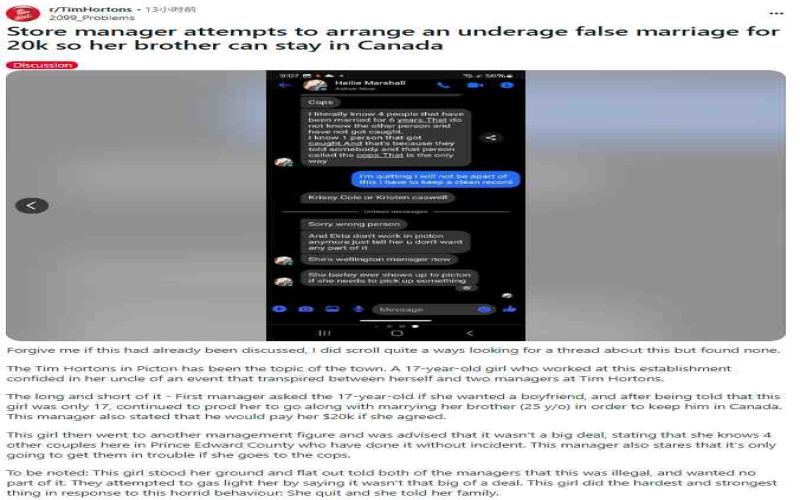
A Tims store in Canada has been exposed: a manager allegedly urged a 17-year-old employee to enter a sham marriage in exchange for permanent residency, while another tip-off claims wages were as low as C$8.
Canadian national coffee brand Tims has recently become embroiled in a public opinion storm on social media. A store in Ontario was accused of a manager suggesting to a 17-year-old employee that they enter a "sham marriage" with the manager's 25-year-old Indian relative to help the latter obtain Canadian permanent residency, promising a payment of 15,000 to 20,000 Canadian dollars. After the individual refused, they resigned and made the chat records public. Local police and immigration authorities have intervened, and Tims headquarters is also investigating. Subsequently, more netizens revealed that after the store changed owners, it gradually dismissed local long-term employees and only hired people of a specific ethnicity, as well as issues such as a hourly wage of only 8 Canadian dollars at a downtown Toronto store and one and a half months of unpaid training, triggering widespread doubts among Canadians about Tims' employment practices and brand reputation. [more…]